

The President is the face of the country. But is he the only person running it?
When Nigerians talk about government, the conversation usually starts and ends with the President.
The President increased fuel prices. The President approved a policy. The President should fix the roads. The President needs to do something about the economy.
And while the President has enormous responsibilities, Nigeria is not run by one person alone.
So, who actually runs Nigeria?
Let’s break it down.
1. THE PRESIDENT IS NOT THE ENTIRE GOVERNMENT
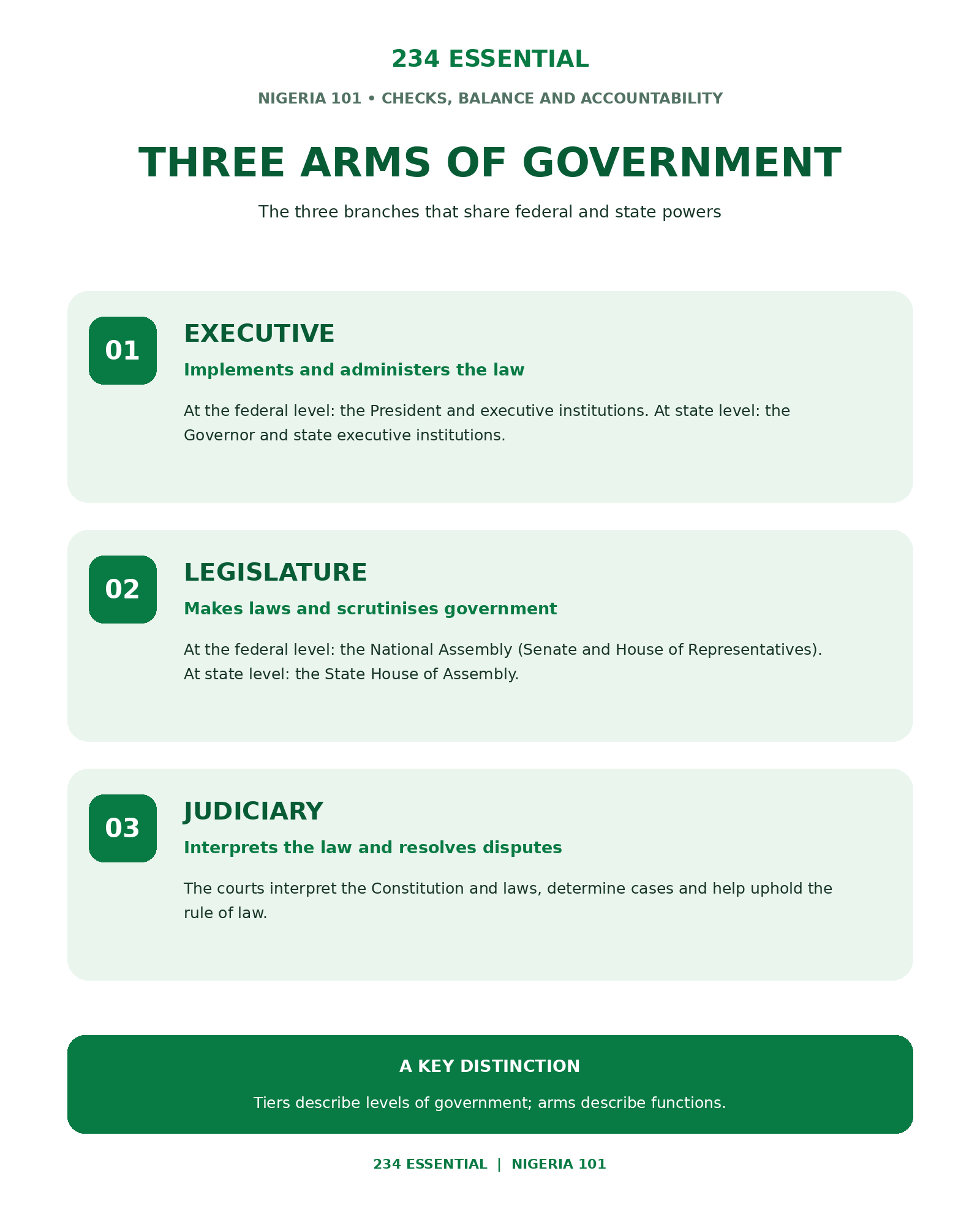
Nigeria’s President is the head of the federal executive. He leads the executive branch at the national level and is responsible for implementing federal laws and directing the work of the federal government.
But he doesn’t personally manage every ministry, approve every government decision, or oversee every public service.
He works with the Vice-President, ministers, advisers, and other government officials. Ministries, departments, and agencies handle different areas of national administration, from education and health to finance, transportation, and national security.
Think of it this way: the President provides executive leadership, but an entire system of institutions and public officials is responsible for turning government decisions into action.
And the President’s powers are not unlimited. The Constitution defines those powers and establishes other institutions that can check how they are exercised.
2. THE GOVERNORS
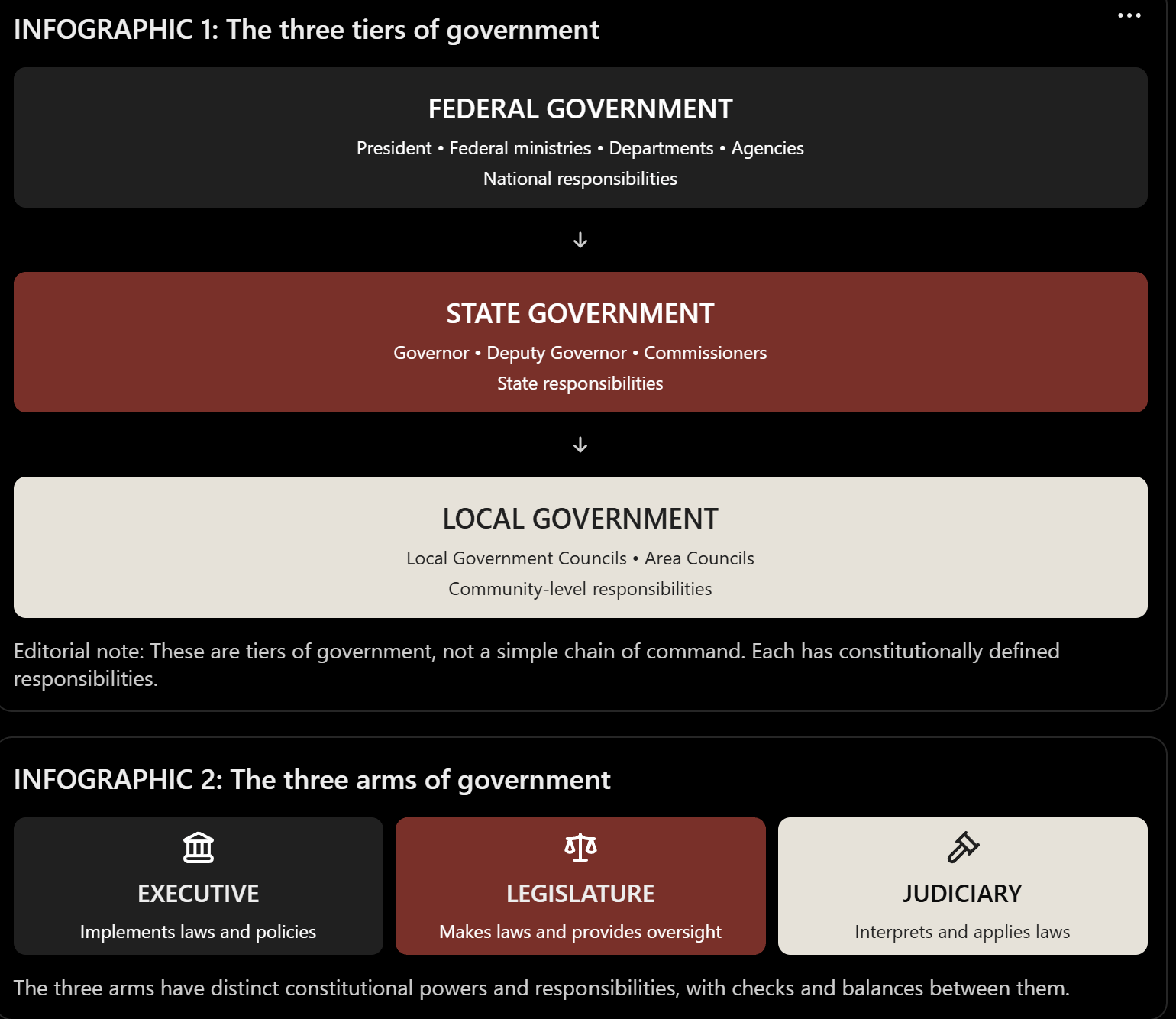
Nigeria operates a federal system of government. This means constitutional powers and responsibilities are distributed between the federal government and the governments of the states.
Each of Nigeria’s 36 states has a governor who heads its executive branch.
Governors work with deputy governors, commissioners, state ministries, and other government bodies to administer their states.
This matters because not every problem in Nigeria is the President’s direct responsibility.
For example, state governments have significant responsibilities for roads, public healthcare, education, and other services within their jurisdiction. However, some of these responsibilities are shared with the federal and local governments.
So, when something goes wrong, the first question shouldn’t always be, “What is the President doing?”
Sometimes, the more useful question is, “Which level of government is constitutionally responsible for this?”
3. WHO RUNS YOUR LOCAL GOVERNMENT?
Beneath the federal and state levels is local government.
Nigeria has 768 constitutionally recognised local government areas across its 36 states, alongside six area councils in the Federal Capital Territory. Together, these are commonly referred to as Nigeria’s 774 local government units.
Local government councils are intended to bring governance closer to the people. Their responsibilities include areas such as local roads, markets, sanitation, public conveniences, and participation in the provision of primary healthcare and primary education.
But here’s something important.
On 11 July 2024, the Supreme Court delivered a landmark judgment affirming the financial autonomy of local governments. Among other things, it ordered that allocations due to local governments should be paid directly to democratically elected councils rather than being controlled through state joint accounts.
Why does this matter?
Because local governments are not simply administrative extensions of state governments. They have constitutionally recognised responsibilities and a role to play in delivering services to communities.
Think about the issues closest to your neighbourhood.
Who is responsible for the local market? Who maintains the roads? Who should explain why a community project has stalled?
These are questions worth asking about your local council, not just the State House or Aso Rock.
Government is not only what happens in Abuja. It is also what happens in your state and community.
4. WHO MAKES THE LAWS, THEN?
Remember our last edition on the three arms of government?
The legislature makes laws.
At the federal level, this is the National Assembly, made up of the Senate and the House of Representatives.
At the state level, each state has a House of Assembly.
Legislators represent their constituents, make laws within their constitutional powers, scrutinise government activities and perform oversight functions.
This means that the President or a governor cannot simply make every decision without legal limits or scrutiny.
Legislatures have their own constitutional responsibilities, including lawmaking, approving certain government appointments and holding the executive accountable.
And that is why knowing who represents your constituency matters.
Your elected representatives are not there simply to appear on campaign posters every four years.
5. WHO MAKES SURE THE RULES ARE FOLLOWED?
That brings us to the judiciary.
Courts interpret the law, resolve disputes, and determine legal questions brought before them.
They can also examine whether government actions comply with the Constitution and other applicable laws.
The judiciary is a separate arm of government. Its role is important because having laws on paper means little if legal disputes cannot be resolved fairly and independently.
Nigeria has federal and state court structures, with the Supreme Court serving as the highest court in the country.
The Constitution establishes the framework within which the executive, legislature, and judiciary exercise their different powers.
No single arm is meant to replace the other two.
6. WHO IS REALLY IN CHARGE?
Here is the important part: there isn’t one person responsible for everything that happens in Nigeria.
The President leads the federal executive. Governors lead state executives. Local government councils handle responsibilities assigned to them. Legislatures make laws and perform oversight, while courts interpret and apply the law.
Government ministries, departments, agencies, and public servants also play important roles in carrying out public responsibilities.
These roles are not always completely separate. Some responsibilities overlap, and different levels of government may share roles.
That is why understanding which institution has the authority to act can make a difference when citizens demand answers.
And there is one more part of the picture: citizens.
Nigerians elect representatives, pay taxes, participate in public discussions, organise around issues and demand explanations from public officials.
Elections are one way citizens influence government, but civic participation does not have to stop after election day.
Knowing how the system works helps us ask better questions, direct complaints to the right offices, and hold the appropriate people accountable.
WHY THIS MATTERS TO YOU
Imagine your community has a road that has been neglected for years.
Instead of simply asking why “the government” has done nothing, you can begin by finding out:
Which level of government is responsible for the road?
Which ministry or agency oversees the project?
Was funding allocated?
Which elected representatives can be asked for an explanation?
You may not get an answer immediately. You may still face delays, poor service, or a lack of transparency.
But you are no longer treating government as one enormous, mysterious institution. You are beginning to understand its parts and how to question them.
You do not have to be a lawyer, politician, or public policy expert to understand how your country works.
You need to know the basics and be willing to ask questions.
Because if we don’t know who is responsible, how do we know who to hold accountable?
Next in Nigeria 101: Elections 101. How do elections actually work, and what are Nigerians voting for when they cast their ballots?
SOURCES & FURTHER READING
Want to understand Nigeria’s government beyond this explainer?
Explore:
The Constitution of the Federal Republic of Nigeria, 1999 (as amended) – The legal foundation for Nigeria’s system of government, including the powers and responsibilities of the executive, legislature and judiciary.
The Supreme Court’s 11 July 2024 judgment on local government financial autonomy – An important development in understanding the constitutional position and funding of local governments.
The Independent National Electoral Commission (INEC) – Learn about elections, voter registration, and the electoral process.
Nigeria 101 is an educational series by 234 Essential. It aims to make Nigerian institutions, public policy, and civic issues easier to understand.1
LET’S TEST YOUR NIGERIA 101 KNOWLEDGE.
Do you know who represents you at each level of government?
Who is your local government chairman?
Who represents your constituency in the State House of Assembly?
Who represents your constituency in the House of Representatives?
Who is your Senator?
How many can you name without searching online?
Understanding government begins with knowing who represents you.
Join the conversation. Tell us how many you got right.
Also, send an email with your response to Fanmail@234Essential.com, and we will read it on the next episode.
#234Essential #Nigeria101 #CivicEducation #KnowYourRepresentatives